



















-
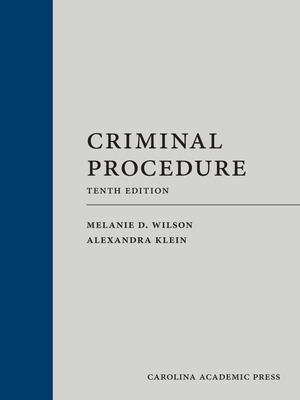
Criminal Procedure (7th ed. 2009)
Joseph G. Cook, Paul Marcus, and Melanie D. Wilson
Criminal Procedure reflects a balanced blend of conventional casebook style, practice problems, concise text, and sample forms and documents that stresses the interplay of constitutional principles and practical considerations that confront both prosecution and defense attorneys. The organizational structure of previous editions is retained and three major subject areas are explored in depth: Arrest, Search, and Seizure; Right to Counsel; and Confessions.
The book contains a host of new and quite fascinating materials related to recent decisions from the Supreme Court. Cases involving the construction of the good faith exception to the exclusionary rule, a rethinking of the car search doctrine, reaffirmation of the McNabb / Mallory rule, and numerous others, will contribute to interesting discussions with students.
-
Anatomy of an Execution: The Life and Death of Douglas Christopher Thomas (2009)
Todd C. Peppers and Laura Trevvett Anderson
It is an undisputed fact that Chris Thomas was guilty of participating in a brutal double homicide. He was convicted of killing his girlfriend’s parents in November of 1990, was sentenced to death in November of 1991, and was executed by the Commonwealth of Virginia in January of 2000. Chris Thomas was one of the last juvenile offenders to be put to death before the Supreme Court ruled that the execution of juveniles constituted cruel and unusual punishment. In Anatomy of an Execution, Todd C. Peppers and Laura Trevvett Anderson tell the entire story, shedding light on issues surrounding the death penalty—such as the quality of court appointed counsel, the execution of juveniles (from both a constitutional law and public policy perspective), conditions of confinement on death row, and the role of spiritual advisors in the condemned’s last days. While providing insight into the legal workings of the modern death penalty system, the book also offers a rare glimpse of a young, condemned man’s life before and after the crime: a childhood ravaged by loss and neglect, a toxic first love, the brutal murders, trial and sentencing, and, ultimately, a chance at redemption. This is not an effort to excuse a crime but an assertion that even a murderer’s life is worth more than its worst act.
-
Complex Litigation: Injunctions, Structural Remedies and Contempt (2009)
Doug Rendleman
Designed for law school complex-litigation and remedies classes that emphasize injunctions and contempt, this casebook also serves as a tool for lawyers’ quick, on-point research into the background and present status of these subjects. Developments in the rapidly changing law in the 25 years since publication of its predecessor, Injunctions, Second, required numerous additions and extensive revision. Part of the University Casebook Series; , it includes selected cases designed to illustrate the development of a body of law on complex litigation. Text and explanatory materials designed for law study accompany the cases.
-
Federal Income Taxation of Trusts and Estates: Cases, Problems, and Materials (3d ed. 2008)
Mark L. Ascher and Robert T. Danforth
Federal Income Taxation of Trusts and Estates: Cases, Problems, and Materials examines the income taxation of estates and trusts, estate and trust beneficiaries, and trust settlors; its emphasis is on the provisions of 'Subchapter J'; the relevant portion of the Internal Revenue Code (sections 641 through 692) and its first priority is to give readers an understanding of those provisions and how they work. The book takes four distinct, but integrated, approaches. At the beginning of each section, Ascher and Danforth present assignments of carefully selected provisions of the Internal Revenue Code and Treasury Regulations. Following are one or more precedents (cases or rulings) dealing with the topic at hand, accompanied by textual material that amplifies the topic by further analysis of the primary precedents, presentation of other precedents, or discussion of subsequent developments. Finally, numerous problems, where appropriate, allow the reader to apply the material to common fact patterns. The third edition brings the book completely up to date, and includes all relevant developments since the preparation of the second edition. Among the many important additions are the decision of the United States Supreme Court in Knight v. Commissioner, which just this year held that investment advisory fees paid by a trustee are subject to the 2% haircut under section 67; Mattie K. Carter Trust v. United States, in which the United States District Court for the Northern District of Texas held that it is not merely the activities of the trustee, but also those of the trustee s employees, that count toward the material participation requirement under the passive activity rules of section 469; and full incorporation of the trust accounting income regulations recently finalized by the Treasury. The third edition includes a number of new or revised problems, and it trims some materials relating to estate planning techniques that are now obsolete.
-
A Hard Look at the Soft Theory of International Criminal Law, in The Theory and Practice of International Criminal Law: Essays in Honor of M. Cherif Bassiouni (Leila Nadya Sadat & Michael P. Scharf eds., 2008)
Mark A. Drumbl
Cherif Bassiouni is often referred to as "the father of international criminal law." Every major international criminal law instrument developed in the last forty years, from the Torture Convention to the Statute of the International Criminal Court, bears his hallmark.
His writings, diplomatic initiatives, fieldwork, and even litigation have made an unparalleled contribution to the emergence of international criminal law as a distinct discipline within the field of international law.
This book contains a collection of fifteen scholarly essays, written by leading experts from around the world, about the theory and practice of modern international criminal law, with a focus on Cherif Bassiouni's unique legacy within this important area.
-
Immunities and Exceptions, in International Criminal Law, Volume II: Multilateral and Bilateral Enforcement Mechanisms (M. Cherif Bassiouni ed., 2008)
Mark A. Drumbl
The definitive treatise on international criminal law, M. Cherif Bassiouni’s unique 3- volume collection is now in its third edition. Written by more than 50 outstanding authorities from 19 countries, it covers the entire field, from the theory of what makes a crime "international" to the step-by-step conduct of an international prosecution.
Volume 2 addresses jurisdiction and the various mechanisms and modalities of international cooperation in penal matters, which for all practical purposes, apply to both the direct and indirect enforcement methods of ICL. These mechanisms and modalities of international cooperation are used not only in bilateral interstate cooperation in penal matters but they are also employed by international tribunals, including the ICC, in their relations with states.
-

Nonqualified Deferred Compensation and the Pre-Statutory Limits on Deferral, in Bender's Federal Income Taxation of Retirement Plans (Alvin D. Lurie ed., 2008)
Brant J. Hellwig
This two-volume treatise is a comprehensive analysis of the complex federal income tax issues affecting retirement plans. It includes the latest developments, complete with Planning Tips, examples and charts to help you design and maintain an efficient pension plan that meets IRS requirements. The treatise provides complete coverage of how to:
- Effectively establish a pension plan;
- Correctly differentiate among the many and varied types of plans;
- Maintain the plan in accordance within statutory requirements, recent changes, and new interpretations of the law;
- Not run afoul of prohibited transactions, and
- Terminate a plan.
-
Atrocity, Punishment, and International Law (2007)
Mark A. Drumbl
This book argues that accountability for extraordinary atrocity crimes should not uncritically adopt the methods and assumptions of ordinary liberal criminal law. Criminal punishment designed for common criminals is a response to mass atrocity and a device to promote justice in its aftermath. This book comes to this conclusion after reviewing the sentencing practices of international, national, and local courts and tribunals that punish atrocity perpetrators. Sentencing practices of these institutions fail to attain the goals that international criminal law ascribes to punishment, in particular retribution and deterrence. Fresh thinking is necessary to confront the collective nature of mass atrocity and the disturbing reality that individual membership in group-based killings is often not maladaptive or deviant behavior but, rather, adaptive or conformist behavior. This book turns to a modern, and adventurously pluralist, application of classical notions of cosmopolitanism to advance the frame of international criminal law to a broader construction of atrocity law and towards an interdisciplinary, contextual, and multicultural conception of justice.
-
Virtual Property and the Overextension of Copyright Licensing Online, in Intellectual Property and Information Wealth: Issues and Practices in the Digital Age (Peter K. Yu ed., 2007)
Joshua A.T. Fairfield
Until recently, issues of intellectual property were relegated to the experts―attorneys, legal scholars, rightsholders, and technology developers who wrangled over interpretations and enforcement of copyright, patent, and trademark protections. But in today's knowledge-based economy, intellectual property protection has taken on fundamentally new proportions, as a subject of urgency for businesses (whose survival depends on protection of their intangible assets) and as a subject of cultural importance that grabs front-page headlines (as the controversy over Napster and high-profile revelations of plagiarism, for example, have illustrated). This landmark set of essays brings new clarity to the issues, as societies around the world grapple with the intricacies and complexities of intellectual property, and its impact on business, law, policy, and culture. Featuring insights from leading scholars and practitioners, Intellectual Property and Information Wealth provides rigorous analysis, historical context, and emerging practical applications from the public, private, and non-profit sectors.
-
An Interview with Judge Ivan L. R. Lemelle, in Seeking Higher Ground: The Hurricane Katrina Crisis, Race, and Public Policy Reader (Manning Marable & Kristen Clarke eds., 2008)
Suzette M. Malveaux
Hurricane Katrina of August-September 2005, one of the most destructive natural disasters in U.S. history, dramatically illustrated the continuing racial and class inequalities of America. In this powerful reader, Seeking Higher Ground, prominent scholars and writers examine the racial impact of the disaster and the failure of governmental, corporate and private agencies to respond to the plight of the New Orleans black community. Contributing authors include Julianne Malveaux, Melissa Harris-Lacewell, Ronald Walters, Chester Hartman, Gregory D. Squires, Mindy Thompson Fullilove, Alan Stein, and Gene Preuss. This reader is the second volume of the Souls Critical Black Studies Series, edited by Manning Marable, and produced by the institute for Research in African-American Studies of Columbia University.
-
Global Issues in Legal Ethics (2007)
James E. Moliterno and George C. Harris
This book is designed to facilitate the introduction of international, transnational, and comparative law issues into a course on Professional Responsibility. The book is very accessible for law students (and their professors). The chapters can be used in any combination and in any order. The book can be assigned or recommended as optional reading to supplement a domestic-only course to advance the students’ understanding of their own system.
-

Evaluating the Estate Tax Exposure of the SCTC Trust Termination Provisions, in The South Carolina Trust Code (James C. Hardin, III & S. Alan Medlin eds., 2006)
Brant J. Hellwig
This book surveys the South Carolina Trust Code, enacted in 2006.
-
Class Actions and Other Multi-Party Litigation: Cases and Materials (2d ed. 2006)
Robert H. Klonoff, Edward K. Bilich, and Suzette M. Malveaux
This casebook focuses on one of the most important and dynamic areas of modern federal and civil practice - aggregate-party litigation, particularly class actions. Examples of such litigation include path-breaking cases involving Agent Orange, breast implants, tobacco, and contraceptive devices. In addition to class actions, the text addresses joinder, consolidation, intervention, impleader, interpleader, multi-district litigation, and bankruptcy, among other topics. It includes rich theoretical materials, as well as practical discussions useful for a student contemplating a professional focus in class actions. The second edition covers major developments since the first edition, including the 2003 amendments to Rule 23 and the Class Action Fairness Act of 2005. It also includes several major Supreme Court and federal court of appeals decisions that have been handed down since the first edition.
-
The Law of Preclearance: Enforcing Section 5 of the Voting Rights Act, in The Future of the Voting Rights Act (David L. Epstein et al. eds., 2006)
J. Peyton McCrary, Christopher B. Seaman, and Richard M. Valelly
The Voting Rights Act (VRA) stands among the great achievements of American democracy. Originally adopted in 1965, the Act extended full political citizenship to African-American voters in the United States nearly 100 years after the Fifteenth Amendment first gave them the vote. While Section 2 of the VRA is a nationwide, permanent ban on discriminatory election practices, Section 5, which is set to expire in 2007, targets only certain parts of the country, requiring that legislative bodies in these areas—mostly southern states with a history of discriminatory practices—get permission from the federal government before they can implement any change that affects voting. In The Future of the Voting Rights Act, David Epstein, Rodolfo de la Garza, Sharyn O'Halloran, and Richard Pildes bring together leading historians, political scientists, and legal scholars to assess the role Section 5 should play in America's future. The contributors offer varied perspectives on the debate. Samuel Issacharoff questions whether Section 5 remains necessary, citing the now substantial presence of blacks in legislative positions and the increasingly partisan enforcement of the law by the Department of Justice (DOJ).
-

Revisiting the American Action for Public Disclosure of Facts, in New Dimensions in Privacy Law: International and Comparative Perspectives (Andrew T. Kenyon & Megan Richardson eds., 2006)
Brian C. Murchison
Although the public disclosure tort has had an unpromising past, it appeals to what Anthony Lewis suggests is a sense of basic fairness to ‘those who have not sought power’ but have become illustrations of public issues. The tort’s weakness may be a function of cultural indifference or constitutional qualms, although the most likely explanation is institutional: until recently, the Supreme Court offered no illumination of a core interest. Libel law had reserved the obvious candidate, dignity, for civic contexts. Now, with the court’s decision in Bartnicki and the insights of a number of contemporary thinkers, it may be time to recognise privacy as a dynamic concept involving the self’s interest in growth through unhampered dialogic exchange. At the core of a reconsidered tort should be an idea of freedom - to engage in a ‘web’ of secure relationships that promote an essential task of human experience: creating what Rorty called ‘stable character in an unstable time’.
-
Courtiers of the Marble Palace: The Rise and Influence of the Supreme Court Law Clerk (2006)
Todd C. Peppers
Courtiers of the Marble Palace is the first systematic examination of the "clerkship institution"—the web of formal and informal norms and rules surrounding the hiring and utilization of law clerks by the individual justices on the United States Supreme Court. Todd Peppers provides an unprecedented view into the work lives of and day-to-day relationships between justices and their clerks; relationships that in some cases have extended to daily breakfasts, games of competitive basketball and tennis, and occasional holiday celebrations. Through personal interviews with fifty-three former clerks and correspondence with an additional ninety, as well as personal interviews with a number of non-clerks, including Justice Antonin Scalia, Peppers has amassed a body of information that reveals the true inner-workings of the clerkship institution.
With a Foreword by Professor Robert M. O'Neil of the University of Virginia School of Law, former President of the University of Virginia and former law clerk for Justice William J. Brennan, Jr.
-
Remedies: Cases and Materials (7th ed. 2006)
Doug Rendleman
Concisely covers the complex subject matter of Remedies with an emphasis on the lawyer's process. Decisions were picked and edited to build on first-year courses in contracts, torts, civil procedure, property, and constitutional law. Text also develops the differing measures of contract and tort damages and the availability of punitive damages for torts.
-
Voices of African Women: Women's Rights in Ghana, Uganda, and Tanzania
Johanna E. Bond
Voices of African Women is a collection of essays by accomplished women’s rights lawyers from Ghana, Uganda, and Tanzania. In the last decade, women’s human rights have been the focus of significant attention at the international level. There remains, however, a dearth of information concerning the application and relevance of international norms at grassroots levels within Africa. There are few works about women’s human rights within Africa that are actually written by African women lawyers and human rights activists. This book offers a glimpse into the lives of women in Ghana, Uganda, and Tanzania; it describes — in their own words — the challenges these activists face in implementing international human rights norms at the local and national levels.
-
United Nations International Court of Justice (ICJ), in Encyclopedia of the Developing World (Thomas M. Leonard ed., 2005)
Mark A. Drumbl
The Encyclopedia of the Developing World is a comprehensive work on the historical and current status of developing countries. Containing more than 750 entries, the Encyclopedia encompasses primarily the years since 1945 and defines development broadly, addressing not only economics but also civil society and social progress. Entries cover the most important theories and measurements of development; relate historical events, movements, and concepts to development both internationally and regionally where applicable; examine the contributions of the most important persons and organizations; and detail the progress made within geographic regions and by individual countries.
-

Choice of Business Entity: Weighing the LLC Against the Alternatives, in South Carolina Corporate Practice Manual (2nd ed. 2005)
Brant J. Hellwig
The South Carolina Corporate Practice Manual, Second Edition is a comprehensive and practical handbook designed for both the general practitioner and corporate specialist. This updated resource tracks the entire process of forming and operating most types of corporate entities. Fully updated since the First Edition, the book includes practical instructions on advising clients about selecting the correct corporate entity, choosing and protecting the corporate name, corporate finance and control, and securities. Model articles, bylaws, resolutions, minutes, tax and other forms are included on CD.
-
The Legal System of Nepal, in Legal Systems of the World: A Political, Social, and Cultural Encyclopedia (Herbert M. Kritzer ed., 2002)
Johanna E. Bond
Legal Systems of the World is the only comprehensive reference work that covers the legal systems of every nation on earth, every state in the Union, and every province of Canada.
- 400 A–Z entries on places from Scotland to Suriname, concepts and terms like legal realism and retribution, and key documents such as the Writ of Certiorari
- Entries by an international team of over 350 contributors
- Highly readable maps of every country in the world, from Afghanistan to Zimbabwe
- Nearly 275 diagrams illustrating the legal structure of various states and countries
- A glossary of hundreds of key terms like "adversarialism" and "sharia"
-

Jointly Owned Property, in Estate Planning Strategies: A Lawyer's Guide to Retirement and Lifetime Planning (Jay A. Soled ed., 2002)
Robert T. Danforth
This comprehensive book is a guide to help circumnavigate the estate-planning world and specific changes EGTRRA has brought and will sensitize lawyers to the estate planning needs of their clients in a legal environment that is in transition. To assist in the navigation process, many of the nation's top estate-planning experts and practitioners have been assembled to participate in the production of this book
-
Violence Against Women and International Human Rights Law, in Sourcebook on Violence Against Women (Claire M. Renzetti et al. eds., 2001)
Johanna E. Bond and Robin Phillips
This textbook comprises a collection of original scholarly writings extensively covering current research on violence against women. It is intended as a resource for students, practitioners, and academics.
-
The (Al)lure of the Genocide Trial: Justice, Reconciliation, and Reconstruction in Rwanda, in Effective Strategies for Protecting Human Rights: Economic Sanctions, Use of National Courts and International Fora and Coercive Power (David Barnhizer ed., 2001)
Mark A. Drumbl
This chapter questions the ability of genocide trials in Rwanda and at the International Criminal Tribunal for Rwanda (ICTR) to attain these goals. In so doing, it also questions the push among international lawyers and activists to ensconce selective criminal prosecution as a preferred, potentially exclusive, and uniform response to mass atrocity. The chapter posits that the key variable that should determine policy responses to genocide is the social geography of the postgenocidal society. Postgenocidal policy instruments, including those designed to promote rule of law, should therefore be contextual. The Rwandan genocide may well be an example of what Carlos Santiago Nino, citing Kant, calls "radical evil". In a restorative justice paradigm, criminal violence is viewed primarily as an injury to individuals and communities, and only secondarily as an injury to the state or international order. Jose Alvarez favorably applies the "civil dissensus" justification for criminal prosecutions in the Balkans and Rwandan conflicts.
-
When May the Right Be Invoked?, in The Privilege Against Self-Incrimination in Civil Litigation (ABA Section of Antitrust Law, 2001)
Julie Schwartz
This book analyzes the application of the constitutional right against self-incrimination to civil litigation. This topic is of growing importance in an era when parallel civil, criminal, and administrative proceedings are becoming increasingly common and practitioners must necessarily consider all of the implications of a witness' decision to invoke, or not invoke, the right against self-incrimination. These decisions have always been, and remain, important in familiar areas of litigation such as antitrust, RICO, and securities. However, with the continued growth of regulatory structures that allow for civil, criminal, and administrative liability-often for essentially the same conduct-and the proliferation of civil forfeiture proceedings that can precede, accompany, or follow a criminal prosecution, the importance of these decisions continues to increase. Counsel for parties and nonparty witnesses must continually grapple with decisions whether to advise individuals to invoke their right against self-incrimination, and counsel for organizations must understand the implications of those invocations for their clients as well.
The Books and Chapters collection highlights published scholarship by members of the faculty at the Washington and Lee University School of Law. The record for each item includes a description of the work, publication information, and a link to purchase or download the text. The works are authored by current and former faculty members and arranged by year of publication and then alphabetically by author's last name, with the most recent at the beginning of the list.
Printing is not supported at the primary Gallery Thumbnail page. Please first navigate to a specific Image before printing.