
















-
Grown-Ups, Grown-Downs, and Pan-Generationality, in Parents, Children, and the Ripples of Transitional Justice (Kirsten J. Fisher & Caitlin Mollica eds., 2026)
Mark A. Drumbl
Until one becomes a grown-up, one perhaps remains a ‘grown-down’. Indeed, a refrain among concerns that have been raised about demobilization programmes for former child soldiers is that they treat former child soldiers as grown-downs, often even as infants, notwithstanding the experiences of these young people in terms of fighting and foraging and fending and fleecing which, indeed, surpass the kinds of challenges that many grown-ups ever face. In the end, then, as Grace Akello has poignantly demonstrated, many decommissioned child soldiers remain grown-downs who end up going down paths on which they shift from armed conflict to drift into criminal violence and, in this way, their reintegration becomes disturbingly hobbled by the recidivism of violence (Akello, 2019). Indeed, these youth may become ground down by the very transnational expert initiatives and programmes that adults develop for them and which often remain devoid of their very own input for the purposes of their very own reintegration. The objects remain as subjects and never become actors (see Beier’s and Fisher and Mugero’s chapters in this book for discussions of the object/ subject dichotomy of children in transitional justice).
-
Nonchalance and the Fascist Gaze, in Reframing Transitional Justice: Innovations, Boundaries, and Refractions (Mark A. Drumbl & Kirsten J. Fisher eds., 2026)
Mark A. Drumbl
The destruction of cultural property is an international war crime, and a push has arisen to make it a crime against humanity. The destruction of cultural property is also central to transitional justice and liberation efforts. These dualities tend to be reconciled by aesthetic judgement on what is ‘ugly’ cultural property, namely, cultural property linked to oppressors, abusers, and tyrants. It is only cultural property that is worthy of protection whose destruction is seen as criminal. In many jurisdictions—the United States, United Kingdom, Canada, Australia, and throughout Central and Eastern Europe—‘ugly’ cultural property is toppled, removed from public spaces, sequestered, destroyed, and renamed. These include Confederate monuments, statuary of settler colonialism, busts of Lenin and Stalin, Nazi relics, etc. Yet this is not the only way to interface with ‘ugly’ cultural property. Italy offers a different approach. This is an approach of nonchalant integration to Mussolini-era monuments and iconography. Through the use of visual ethnography, this paper phenomenologically narrates this approach through the eyes of one outsider.
-
Reframing Transitional Justice: Innovations, Boundaries, and Refractions (Mark A. Drumbl & Kirsten J. Fisher eds., 2026)
Mark A. Drumbl and Kirsten J. Fisher
This book challenges the simplicity, predestination, and self-evident nature of contemporary narratives of transitional justice.
Transitional justice is the field of study that examines how states should reckon with massive human rights abuses. The book upends these assumptive narratives on three crucial fronts. The first front is that of innovations. Here, the book questions the ability of transitional justice to deliver tangible successes in an era of rapid and overwhelming technological change and contestation over what constitutes human memory, communicative dialogue, and reliable evidence. The second front involves boundaries. Here the book confronts the professed superpower of transitional justice to do more and more, in an endless concatenation of additives. While there is cause for optimism, this book also suggests that transitional justice remains awkward in how it copes with the existential pressures of environmental, health, and cultural crises. On its third front, refractions, this book identifies how transitional justice addresses racism, misogyny, and democratic backsliding. How the prism of transitional justice interventions refracts these scourges remains inadequate. Throughout, the book asks readers to imagine where the field and practice of transitional justice could go from here—what new innovations are required, what boundaries must be stretched or retrenched, and what perspectives need to be considered due to new ways of seeing current and past atrocities.
Accordingly, this book will be of considerable interest to academics, practitioners working on post-conflict reconstruction, and students at all levels ranging from undergraduate to post-doctoral in the areas of law, politics, cultural property, criminology, human rights, international relations, and technology studies.
-
Death Penalty Administration, Global, in The Sage Encyclopedia of Crime and Gender (Janet P. Stamatel ed., 2026)
Alexandra Klein
The Sage Encyclopedia of Crime and Gender is an extensive survey of how gender shapes law, crime, and justice across the areas of the legal system, criminal offending and victimization, criminal justice processes and outcomes, and crime prevention strategies. It provides a multi-dimensional view of relationships between gender and crime by balancing theory and empirical research, contemporary and historical perspectives, domestic and global contexts, and interdisciplinary insights. Most importantly, it offers a comprehensive examination of gender that moves beyond biological binary conceptions of sex to include various gender identities, sexual orientations, and gender expressions.
-
Thaler and Contextually Sound AI Regulation, in Recreating Creativity, Reinventing Inventiveness: AI and Intellectual Property Law (Nikos Koutras & Niloufer Selvadurai eds., 2026)
Nikos Koutras and Joshua Fairfield
Artificial intelligence decision-making poses a thorny regulatory problem, largely because theorists and regulators assume that AI plays the same role in human legal systems that humans do. The general assumption is that the legal context for human regulation is the same as the legal context for AI regulation. For example, asking the question: “Is an AI an inventor?" only makes sense if one assumes that an AI “inventor”, whatever that means, can be fitted into the legal framework intended for human inventors, should be rewarded with a state-granted monopoly, can meaningfully be sanctioned for bad behaviour, and so on. We argue they cannot. This chapter theorises, describes, and advocates for a general system of artificial intelligence regulation based on the idea that human incentive-generating institutions like profit, sanction, liability, ex ante explainability and the like fail to influence AI’s decision-making towards human welfare. Rather, we propose, the straightforward solution is to reward and sanction humans who develop and deploy AI for the damages or benefits those deployed products bring to other humans. This chapter will use Thaler v. Commissioner of Patents [2021] FCA 879 and related cases as grounding examples. Our focus is not on the specific outcomes of the cases but rather on the problems for regulation of AI that the cases highlight. We propose that existing legislation may not be able to address the challenges posed by AI technology and thus advance a concrete set of policy moves to create a general system of artificial intelligence regulation. Fortunately, our policy intervention requires no great changes: humans are responsible for the AI they deploy, and those systems of reward and sanction are presently in place. Our approach contains a methodological critique as well. The Thaler cases are emblematic of a series of attempts to backdoor AI into legal personhood through an impoverished view of the meaning of words. If legal words derive meaning solely through their definitions, then statements like “an AI can be an ‘inventor’" have a certain surface plausibility. We note that words draw their meaning from an entire community and context of meaning, and that more attention to how legal terms gain meaning will prevent courts from stumbling into profoundly inapt legal regulatory regimes for AI.
-
Gilbert Law Summaries: Criminal Procedure (21st ed. 2026)
Paul Marcus, Melanie D. Wilson, and Joëlle Anne Moreno
Everything you need to master criminal procedure and improve your exam performance: Fourth Amendment searches, seizures, and arrests; Exclusionary rule; Miranda and the Fifth Amendment privilege against self-incrimination; Sixth Amendment trial rights (speedy trial, jury trial, right to counsel); Bail; Brady disclosure obligations; Burden of proof; Guilty pleas; Sentencing and the death penalty; Double jeopardy; Appellate and habeas corpus rights; Juvenile justice.
Whether you're supplementing your casebook or studying solo, this is your complete roadmap to criminal procedure. Skip the unpredictable online searches and contradictory sources. This guide provides accurate, current, exam-focused content with visual aids and practice study and multimodality exam questions and sample answers. It is written by law professors and clearly organized to help you better understand and retain these important legal concepts. -
Children and Violence: Agency, Experience, and Representation in and beyond Armed Conflict (Christelle Molima Bameka et al. eds., 2025)
Christelle Molima Bameka, Jastine C. Barrett, Mohamed Kamara, Karl Hanson, and Mark A. Drumbl
This multi- disciplinary volume provides an innovative approach to children and violence, looking beyond the existing literature that focuses on child soldiers in the ‘Global South.’
Harnessing expert contributions from over a dozen countries, the book examines the relationship between children and violence, with a focus on children ensnared in military conflict, embroiled in criminal gangs, and enmeshed in political activism. It analyses how children join fights, how they fight, and what happens to them after fighting officially ends. It addresses cutting- edge issues such as cyberwars, self-defence, intergenerational trauma, gender fluidity, racism and state surveillance. Throughout, the book underscores the need to respect the agency and dignity of children and youth, to build cultures of juvenile rights, and to think critically of the place of the child amid global power politics and decolonisation. Through accessible writing, and the provision of considerable new data, this book supports advocacy work and will enrich teaching and spark further academic research.
This book will be of great interest to students of International Law, Human Rights, Childhood Studies, International Relations, Peace and Conflict Studies, Post- Conflict Studies, and Security Studies.
-
Introduction, in Children and Violence: Agency, Experience, and Representation in and beyond Armed Conflict (Christelle Molima Bameka et al. eds., 2025)
Christelle Molima Bameka, Mohamed Kamara, and Mark A. Drumbl
This multi-disciplinary volume provides an innovative approach to children and violence, looking beyond the existing literature that focuses on child soldiers in the ‘Global South.’
Harnessing expert contributions from over a dozen countries, the book examines the relationship between children and violence, with a focus on children ensnared in military conflict, embroiled in criminal gangs, and enmeshed in political activism. It analyses how children join fights, how they fight, and what happens to them after fighting officially ends. It addresses cutting- edge issues such as cyberwars, self-defence, intergenerational trauma, gender fluidity, racism and state surveillance. Throughout, the book underscores the need to respect the agency and dignity of children and youth, to build cultures of juvenile rights, and to think critically of the place of the child amid global power politics and decolonisation. Through accessible writing, and the provision of considerable new data, this book supports advocacy work and will enrich teaching and spark further academic research.
This book will be of great interest to students of International Law, Human Rights, Childhood Studies, International Relations, Peace and Conflict Studies, Post- Conflict Studies, and Security Studies.
-

The Character of International Law: A Festschrift for Rob Cryer (Emma J. Breeze, Mark Drumbl, Gerry Simpson & Marianne Wade eds., 2025)
Emma J. Breeze, Mark Drumbl, Gerry Simpson, and Marianne Wade
Professor Robert Cryer was a foundational voice in modern international criminal law. This book celebrates his character, his life, his work, and his influence.
The book is a Festschrift of love and admiration to a voice that is dearly missed. Fittingly, the book also continues to voice the many conversations that Rob started. It thereby doubles as a critical examination of the life of international law.
The book constellates 17 expertly-authored chapters nurtured by four editors through five distinctive sections, each of which reflects on the character of international law. These sections, presented as acts, are: discipline and borders, (re)imagination and continuity, violence and reckoning, acoustics and storytelling, and friendship and kindness.
A wide gamut of touchpoints dovetails into a beautifully eclectic medley. These include criminal law, the law of war, music and harm, gender-based violence, nuclear weapons and artificial intelligence, law after war, the crime of aggression, drones and targets, the domestication of international law, and the role of law in inter-state relations. The book journeys to many places, including Japan, Bosnia and Ukraine, while reflecting on the role of teaching and mentorship in the life of international law.
-

Introduction: To Remember and Smile, in The Character of International Law: A Festschrift for Rob Cryer (Emma J. Breeze, Mark Drumbl, Gerry Simpson & Marianne Wade eds., 2025)
Emma J. Breeze, Gerry John Simpson, and Mark Drumbl
Professor Robert Cryer was a foundational voice in modern international criminal law. This book celebrates his character, his life, his work, and his influence.
The book is a Festschrift of love and admiration to a voice that is dearly missed. Fittingly, the book also continues to voice the many conversations that Rob started. It thereby doubles as a critical examination of the life of international law.
The book constellates 17 expertly-authored chapters nurtured by four editors through five distinctive sections, each of which reflects on the character of international law. These sections, presented as acts, are: discipline and borders, (re)imagination and continuity, violence and reckoning, acoustics and storytelling, and friendship and kindness.
A wide gamut of touchpoints dovetails into a beautifully eclectic medley. These include criminal law, the law of war, music and harm, gender-based violence, nuclear weapons and artificial intelligence, law after war, the crime of aggression, drones and targets, the domestication of international law, and the role of law in inter-state relations. The book journeys to many places, including Japan, Bosnia and Ukraine, while reflecting on the role of teaching and mentorship in the life of international law.
-
The (Self) Identity of the Child Soldier: International Law and Best Practices, in Children’s Right to Identity, Selfhood and International Family Law (Marilyn Freeman & Nicola Taylor eds., 2025)
Mark Drumbl
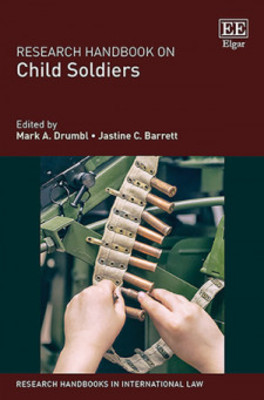
This chapter discusses children associated with armed forces or armed groups, colloquially known as ‘child soldiers’. It sets out the legal definition of child soldiers and unpacks international law and policy practices that address children in armed conflict, including Article 38 of the UNCRC, the Optional Protocol on the Involvement of Children in Armed Conflict, and international criminal law. The law that allocates responsibility for child soldiering and the responsibility of child soldiers for their conduct is reviewed. Return to civilian life is possible through disarmament, demobilisation, and reintegration programmes. These must ensure respect for the self-awareness, agency, and identity affirmations of former child soldiers as part of creating durable social reintegration and the cultivation of viable cultures of children's rights to guard against pernicious gerontocracy. The child's perception of self-identity may change during armed conflict, and this ought to be respected rather than ignored or overlooked.
-
Children as Informers and Denouncers, in Children and Violence: Agency, Experience, and Representation in and beyond Armed Conflict (Christelle Molima Bameka et al. eds., 2025)
Mark A. Drumbl and Barbora Holá
This chapter explores the use of children in propaganda and informing networks as forms of violence. While this chapter nests in 20th- century Communism in the Soviet Union and Czechoslovakia, the interface of children with these networks is not unique to these times and places. Indeed, these experiences link to those elsewhere, thereby elucidating the dually manipulated and agentic role of children in a regime’s fight for legitimacy and thereby blending with a number of contributions to this volume including those by Mohamed Kamara and Sylvie Bodineau. The point of this chapter is not to particularise (or pathologise) Soviet and Czechoslovak approaches to youth mobilisation, but rather to unpack these as examples of far wider phenomena. We thereby shed light on the imagery and iconography of ‘childhood’ in public life. The specific historical analysis in this chapter, however, does suggest there is much more to learn about children and violence than offered by literature about ‘new wars’ in the Global South and that historical developments in Central and Eastern Europe also offer rich insights. We also touch upon the blurring of lines between the public and private, the political and the personal, the family and the state – and the reciprocal machinating of one by the other. This chapter – in the spirit of this edited volume as a whole – transcends a rigid and binary division between childhood and adulthood solely based on chronological age of 18. Age is instead presented as a continuum, with childhood experiences seen as informing adulthood, and dotted in between by the interstitiality of categories such as youth, adolescent, and juvenile. Indeed, the experiences of children and adults in fights may evince continuities rather than the prevailing (and often totalising) presumption of stark differences.
-

Tokyo IMT: Another Sequel to a Prequel, in The Character of International Law: A Festschrift for Rob Cryer (Emma J. Breeze, Mark Drumbl, Gerry Simpson & Marianne Wade eds., 2025)
Mark Drumbl and Solange Mouthaan
Professor Robert Cryer was a foundational voice in modern international criminal law. This book celebrates his character, his life, his work, and his influence.
The book is a Festschrift of love and admiration to a voice that is dearly missed. Fittingly, the book also continues to voice the many conversations that Rob started. It thereby doubles as a critical examination of the life of international law.
The book constellates 17 expertly-authored chapters nurtured by four editors through five distinctive sections, each of which reflects on the character of international law. These sections, presented as acts, are: discipline and borders, (re)imagination and continuity, violence and reckoning, acoustics and storytelling, and friendship and kindness.
A wide gamut of touchpoints dovetails into a beautifully eclectic medley. These include criminal law, the law of war, music and harm, gender-based violence, nuclear weapons and artificial intelligence, law after war, the crime of aggression, drones and targets, the domestication of international law, and the role of law in inter-state relations. The book journeys to many places, including Japan, Bosnia and Ukraine, while reflecting on the role of teaching and mentorship in the life of international law.
-
Give It Back: Title in Digital Property, in The Cambridge Handbook of Emerging Issues at the Intersection of Commercial Law and Technology (Stacy-Ann Elvy & Nancy S. Kim eds., 2025)
Joshua Fairfield and Nathaniel (Nate) Reynolds
The Cambridge Handbook of Emerging Issues at the Intersection of Commercial Law and Technology is a timely and interdisciplinary examination of the legal and societal implications of nascent technologies in the global commercial marketplace. Featuring contributions from leading international experts in the field, this volume offers fresh and diverse perspectives on a range of topics, including non-fungible tokens, blockchain technology, the Internet of Things, product liability for defective goods, smart readers, liability for artificial intelligence products and services, and privacy in the era of quantum computing. This work is an invaluable resource for academics, policymakers, and anyone seeking a deeper understanding of the social and legal challenges posed by technological innovation, as well as the role of commercial law in facilitating and regulating emerging technologies.
-

Progressive Prosecution and the Progressive Prosecutor Movement, in Oxford Research Encyclopedia of Criminology (Henry Pontell ed., 2025)
Sarah Gottlieb
A new kind of prosecutor has gained attention across the United States. Instead of running campaigns based on tough-on-crime promises and draconian sentencing, these prosecutors promise to use their power and discretion to enact criminal legal reforms. These new prosecutors believe that the incarceration-led approaches of the past have caused harm rather than solved it. They campaign on reducing mass incarceration, holding police officers accountable, and addressing the disparities in the criminal legal system. Those who support this movement believe that these prosecutors can be the main drivers of reform within the criminal legal system.
These new prosecutors are called “progressive prosecutors,” although there is no widely accepted definition of the term. There is debate within and outside of the legal community about what it means to be a progressive prosecutor. Scholars and activists disagree about whether it is possible for those tasked with charging and incarcerating defendants to be the drivers behind large-scale criminal reforms. Supporters of the progressive prosecutor movement believe not only that prosecutors are the best situated to achieve large-scale criminal reforms but also that they have an obligation to do so, given their role in perpetuating mass incarceration and racial disparities in the criminal legal system. Prison abolitionists do not believe that prosecutors can enact this change. They argue that progressive prosecutors will only give further legitimacy to a system that perpetuates racism and violence. There is also debate regarding whether the progressive reforms being implemented by these new prosecutors are achieving the goals and results the movement envisioned.
Regardless of the efficacy of their reforms, progressive prosecutors have been targeted by those who do not agree with their reform-oriented approach. Governors have removed prosecutors from their democratically elected positions, legislatures have passed preemption laws, and recall elections have been held. This pushback has resulted in discretion and power being stripped from prosecutors in unprecedented ways. Despite these efforts, progressive prosecutors continue to run successful campaigns across the United States, representing larger populations and more areas than ever before, and attempting to implement reforms to the criminal legal system.
-
The Pathology of Passivity: Shareholder Passivity as a False Narrative in Corporate Law, in Hidden Fallacies in Corporate Law and Financial Regulation (Alexandra Andhov et al. eds., 2025)
Sarah C. Haan
Featuring incisive research from preeminent scholars in the field, this seminal work interrogates long-standing assumptions and beliefs that have remained unexamined for decades. Taking a novel approach, the book serves as both a conceptual 'deconstruction' and a foundation for future research directions. Each chapter delves deep into the often-overlooked origins, mechanics and implications of outdated or misleading concepts (termed 'fallacies') that form the backbone of contemporary corporate and securities laws, financial regulations and related domains. Beyond simply identifying these fallacies, the authors illustrate the profound implications of recalibrating our analytic perspectives. By expanding the spectrum of inquiry and moving along multiple continuums – such as public to private, micro to macro, transactional to structural, individual to systemic, and static to dynamic – this volume underscores the transformative potential of re-envisioning the fundamentals of these fields. An essential read, this book promises to be a catalyst for change and a must-have for anyone committed to staying at the forefront of law and policy.
-
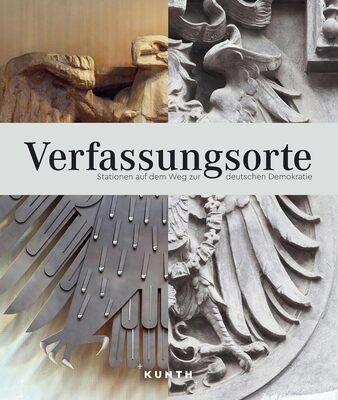
Verfassungsorte: Stationen auf dem Weg zur deutschen Demokratie (2025)
Russell A. Miller, Markus Lang, Kai-Michael Sprenger, and Alexander Telesniuk
In-depth insights into 26 historical sites that shaped the development of German democracy. This visually stunning illustrated book depicts important milestones in German constitutional history at specific locations and buildings, encompassing events from the election of the emperor and the eternal Reichstag, through the draft constitutions of the 19th century and the Weimar Constitution, to the adoption of the Grundgesetz 75 years ago and the integration of the German Constitution into the European institutions. Photographs by Alexander Telesniuk showcase the architectural beauty and symbolic significance of these sites.
- Unique compendium of 26 sites where German history was written
- In-depth texts by renowned experts
- Exclusive, large-format photos with historical images
This illustrated book is a must-have for anyone interested in German history and politics and a homage to democracy.
Available in English as Constitutional Places: Landmarks on the Road to German Democracy, upon request from Markus Lang ([email protected]).
-
Criminal Procedure (10th ed. 2025)
Melanie D. Wilson and Alexandra Klein
The tenth edition of Criminal Procedure focuses on the Fourth Amendment search and seizure provision, the Fifth Amendment protection against unlawful confessions, the Sixth Amendment right to counsel, and more. It effectively covers all of the foundational constitutional criminal procedure concepts and recent U.S. Supreme Court cases, including those analyzing Miranda's constitutional status and searches of smart phones and historical cell phone records, as well as the use of canine officers to conduct searches.
In addition, the book includes a number of notes, questions, and problems exploring state and lower federal court cases interpreting Supreme Court precedent to address existing and developing criminal procedure issues. It also provides several forms and examples to help students fully appreciate and analyze key principles of constitutional criminal procedure.
-
Washington and Lee School of Law Library, in Organizational Structures of Academic Law Libraries: Past, Present, and Future, Vol. 2 (Jessica de Perio Wittman & Elizabeth G. Adelman eds., 2024)
Michelle Cosby
There are 3 academic law library model structures: autonomous, semi-autonomous, and the shared services model:
- An autonomous law school library is a library that is part of an independent law school or one that, despite being on a university campus, operates independently from the central campus library. The director of an autonomous law library reports to the dean of the law school. Typically, the law library’s budget is allocated from the law school budget at the discretion of the dean.
- A semi-autonomous law library is administratively connected to both the law school it serves and the university’s central library. The director of a semi-autonomous law library reports to the dean of the law school and to the university librarian. The semi-autonomous law library’s budget is typically derived from the central library’s funds.
- In the shared services model, an autonomous law library has consolidated select services with the central library, but the remaining reporting structure and budget resemble those of an autonomous law library.
During the last decade many institutions have considered the possibility of transitioning to a different law library structure because it appears to be a path for the institution to save money. This book will shed light on the different structures and the issues associated with each by hearing from law school deans, directors of the law library, and even university librarians.
-
The Sights, Sounds, and Silences of International Law During the Cold War, in Sights, Sounds, and Sensibilities of Atrocity Prosecutions (Mark A. Drumbl & Caroline Fournet eds., 2024)
Mark A. Drumbl
This chapter examines the sounds, sights, and sensibilities of international law during the Cold War. By adopting a sensory lens, this chapter disrupts the common understanding of international law during the Cold War as languishing in a period of hiatus and stagnation. This chapter proceeds through three experiential case studies rooted in a museum, in street protests, and in science fiction literature respectively. This chapter thereby touches upon the episteme (from where do we know what we know about law?) and the place of the senses in that knowledge-base, as well as method (how do the senses present a way to talk, express, experience, and construct law?). This chapter proposes a methodology central to this entire book, namely to expand the conversation about law formation and law enforcement to incorporate moments in time, sensory inputs, and the power of allegory and individual experience. And hereby lies the ‘methodology’ of this book, the methodology of this aesthetic project, through which we aim diversify how international lawyers engage with law while embracing (instead of avoiding) the salience of emotion and the centrality of sentiment.
-
Introduction, in Sights, Sounds, and Sensibilities of Atrocity Prosecutions (Mark A. Drumbl & Caroline Fournet eds., 2024)
Mark A. Drumbl and Caroline Fournet
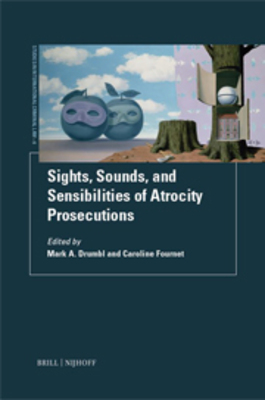
This book unlocks the look, sound, smell, taste, and feel of justice for massive human rights abuses. Twenty-nine expert authors examine the dynamics of the five human senses in how atrocity is perceived, remembered, and condemned. This book is chockful of images. It serves up remarkably diverse content. It treks around the globe: from Pacific war crimes trials in the aftermath of the Second World War to Holocaust proceedings in contemporary Germany, France, and Israel; from absurd show trials in Communist Czechoslovakia to international courtrooms in Arusha, Phnom Penh, and The Hague. Readers embark on a journey that transcends myriad dimensions, including photographic representations of grandfatherly old torturers in Argentina, narco-trafficking in Mexico, colonialisation in India, disinformation and misinformation pixelated in cyberspace, environmental degradation in Cambodia, militarism in Northern Ireland, and civil rights activism in Atlanta. Sights, Sounds, and Sensibilities of Atrocity Prosecutions reimagines what an atrocity means, reconsiders what drives the manufacture of law, and reboots the role of courtrooms and other mechanisms in the pursuit of justice. It unveils how law translates sensory experience into its procedures and institutions, and how humanistic inputs shape perceptions of right and wrong. This book thereby offers a refreshing primer on the underappreciated role of aesthetics, time, and emotion in the world of law.
-
Sights, Sounds, and Sensibilities of Atrocity Prosecutions (Mark A. Drumbl & Caroline Fournet eds., 2024)
Mark A. Drumbl and Caroline Fournet
This book unlocks the look, sound, smell, taste, and feel of justice for massive human rights abuses. Twenty-nine expert authors examine the dynamics of the five human senses in how atrocity is perceived, remembered, and condemned. This book is chockful of images. It serves up remarkably diverse content. It treks around the globe: from Pacific war crimes trials in the aftermath of the Second World War to Holocaust proceedings in contemporary Germany, France, and Israel; from absurd show trials in Communist Czechoslovakia to international courtrooms in Arusha, Phnom Penh, and The Hague. Readers embark on a journey that transcends myriad dimensions, including photographic representations of grandfatherly old torturers in Argentina, narco-trafficking in Mexico, colonialisation in India, disinformation and misinformation pixelated in cyberspace, environmental degradation in Cambodia, militarism in Northern Ireland, and civil rights activism in Atlanta. Sights, Sounds, and Sensibilities of Atrocity Prosecutions reimagines what an atrocity means, reconsiders what drives the manufacture of law, and reboots the role of courtrooms and other mechanisms in the pursuit of justice. It unveils how law translates sensory experience into its procedures and institutions, and how humanistic inputs shape perceptions of right and wrong. This book thereby offers a refreshing primer on the underappreciated role of aesthetics, time, and emotion in the world of law.
-
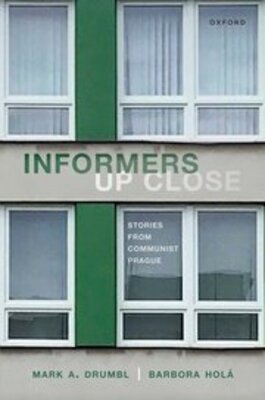
Informers Up Close: Stories from Communist Prague (2024)
Mark A. Drumbl and Barbora Holá
Informers are generally reviled. After all, 'snitches get stitches.' Informers who report to repressive regimes are particularly disdained. While informers may themselves be victims enlisted by the state, their actions cause other individuals to suffer significant harm. Informers, then, are central to the proliferation of endemic human rights abuses. Yet, little is known about exactly why ordinary people end up informing on--at times betraying--other people to state authorities.
Through a case-study of Communist Czechoslovakia (1945-1989) that draws from secret police archives, oral histories, and a broad gamut of secondary sources, this book unearths what fuels informers to speak to the secret police in repressive times and considers how transitional justice should approach informers once repression ends.
This book unravels the complex drivers behind informing and the dynamics of societal reactions to informing. It explores the agency of both informers and secret police officers. By presenting informers up close, and the relationships between informers and secret police officers in high resolution, this book centres the role of emotions in informer motivations and underscores the value of dignity and reconciliation in transitional reconstruction. This book also leverages research from informing in repressive states to better understand informing in so-called liberal democratic states, which, after all, also rely on informers to maintain law and preserve order.
-
Atrocity Then, Trial Now: The Aesthetics, Acoustics, and Visualities of Prosecuting Oskar Gröning, in Sights, Sounds, and Sensibilities of Atrocity Prosecutions (Mark A. Drumbl & Caroline Fournet eds., 2024)
Caroline Fournet and Mark A. Drumbl
Charged with aiding and abetting in the murder of three hundred thousand Hungarian Jews deported to Auschwitz between 16 May 1944 and 11 July 1944, Oskar Gröning, the ‘bookkeeper of Auschwitz’, was sentenced in 2015 by the Lüneburg Regional Court to four years’ imprisonment.
After a series of unsuccessful appeals, Gröning died in 2018, at the age of 96, having never spent a day in jail. This contribution unpacks the charges against Gröning and his resultant conviction; examines the involvement of elderly victims as accusers and their roles in this trial; and, ultimately, contemplates how it all ‘looked’ and ‘sounded’. The focus is thus not only on Gröning himself, but on the totality of the trial of Gröning. Throughout, this contribution gazes upon the aesthetics, acoustics, and visualities of this trial and interrogates the representational credibility of dallied proceedings that occur seventy – increasingly, eighty – years after the fact.
This chapter concludes by positing that however absurd it may seem to put a feeble old man on trial, the feebleness that oozes from not prosecuting such a man may prove even more absurd.
-
Negative Aesthetic Experiences of Prosecuting the Barely Alive, in Sights, Sounds, and Sensibilities of Atrocity Prosecutions (Mark A. Drumbl & Caroline Fournet eds., 2024)
Shannon Fyfe
Theories of negative aesthetics claim that some aesthetic qualities like disgust, ugliness, and repulsiveness are instrumentally valuable, and can be justified as a necessary means to producing what might be considered an ultimately positive aesthetic experience. In an international criminal trial, the presentation of ‘ugly’ visual and oral evidence may be justified in service of the aims of the trial. But when the ‘barely alive’ are prosecuted, however, a justification for a negative aesthetic experience may not exist. In this paper, I argue that due to their vulnerability and the need to protect their dignity, individuals who have been accused of mass atrocity crimes but who are nearing the end of their lives should generally not be subjected to public trial and punishment. The negative aesthetic experiences generated by displaying someone close to death in that setting cannot be justified by positive aesthetic or moral experiences.
The Books and Chapters collection highlights published scholarship by members of the faculty at the Washington and Lee University School of Law. The record for each item includes a description of the work, publication information, and a link to purchase or download the text. The works are authored by current and former faculty members and arranged by year of publication and then alphabetically by author's last name, with the most recent at the beginning of the list.
Printing is not supported at the primary Gallery Thumbnail page. Please first navigate to a specific Image before printing.